Tuesday, June 24, 2014

Dracunculus vulgaris, the Dragon Arum or Snake Lily

The strange and unusual Dragon Arum or Snake Lily, aka Dracunculus vulgaris, despite its exotic look, can be grown relatively easily in a partially shaded garden in zones 5-8. These photos are of a specimen at the Niagara Parks' School of Horticulture & Botanical Gardens.

Even the foliage is ornamental, with the large, ruffled leaves arranged in sets of three and consisting of a snake-skin pattern.

Of course the flower is the main attraction with the purple-red spathe sending up an almost black "jack" (or spadix).

At some point in the maturing process, the flower begins to small like carrion for about a day, attracting flies to do their pollination business. This particular specimen did not smell yet, thankfully.

This is a very cool plant, native to the Balkans and Greece, the isle of Crete, the Aegean Islands, and up into Turkey.

Here's to dirt under your nails.

Mark, the coolplantsguy

Thursday, June 12, 2014

The Fern-leaf Peony

The Fern-leaf Peony, aka Paeonia tenuifolia, is a very unique but well-known and popular perennial. It has several forms and has also been used in hybridization. 


Due to its relative difficulty or slowness in propagation, the retail price is typically above average for a Peony, but well worth it in my opinion!

Here's to dirt under your nails.

Mark, the coolplantsguy

Sunday, July 24, 2011

Hosta 'Gold Standard'

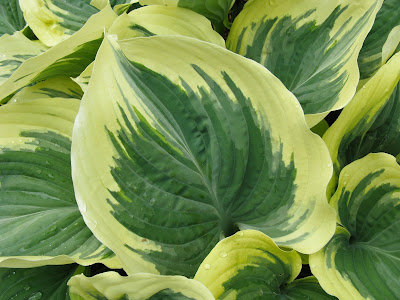
A back-lit leaf of Hosta 'Gold Standard', perhaps the most significant cultivar ever introduced.


Tuesday, August 17, 2010

Hosta 'Liberty'

Very rarely it seems, does one come across a specimen of a plant that instantly and dramatically takes them aback, especially one of a variety that they are somewhat familiar with. But such was the case this summer, when I observed a relatively mature Hosta 'Liberty' in all its glory in the garden of Bruce Cumpson (Olde Towne Gardens, Niagara-on-the-Lake).

Registered in 2000 as a sport of 'Sagae', it has gained some popularity in the industry, but nowhere near as much as what it warrants, at least in my opinion. Amongst Bruce's collection, it was easily the most dramatic -- a true standout from several metres way. I planted one in my own garden the next day.

I had actually grown it for several years at the nursery, but at some point had became disappointed with the variety. But that has certainly changed after seeing this beauty, and we are growing it once again! It certainly underlines the fact that mature specimens are generally the only way to observe and evaluate a Hosta variety.

Interestingly, it is a patented variety, and I can recall a conversation with Yoshimichi Hirose (variegated plant guru from Japan) who insisted that this plant had previously exsisted in Japan prior to its discovery, naming and patenting in the U.S. Such is the life of Hostas and plant-patents I guess. The new Zilis encyclopaedia lists four other varieties as being similar to 'Liberty'.

In any case, if you are going to plant one Hosta in 2011, make it 'Liberty'. You will not be disappointed.

Here's to dirt under your nails.

Mark, the coolplantsguy

Sunday, June 13, 2010

Lilium 'Painted Ladies'

Several years ago, I was fascinated by a "new" offering in Jelitto's latest catalogue listed as Lilium Martagon-Hybr. 'Painted Ladies'. The photograph showed an arrangement of stems consisting of flowers in an interesting assortment of colours.

I was somewhat familiar with L. martagon (Martagon or Turk's Cap Lily) and knew it was a valuable plant in the garden, particularly in areas of dry shade. Nursery production of the species or its white-flowered form 'Album' was seemingly difficult from the usual "bareroot" bulb method. Seed propagation I understood, would be moderately difficult, and plants would take at least a couple of years to mature to flowering size. For these intriguing 'Painted Ladies' however, I believed that the extra effort would ultimately be rewarding.

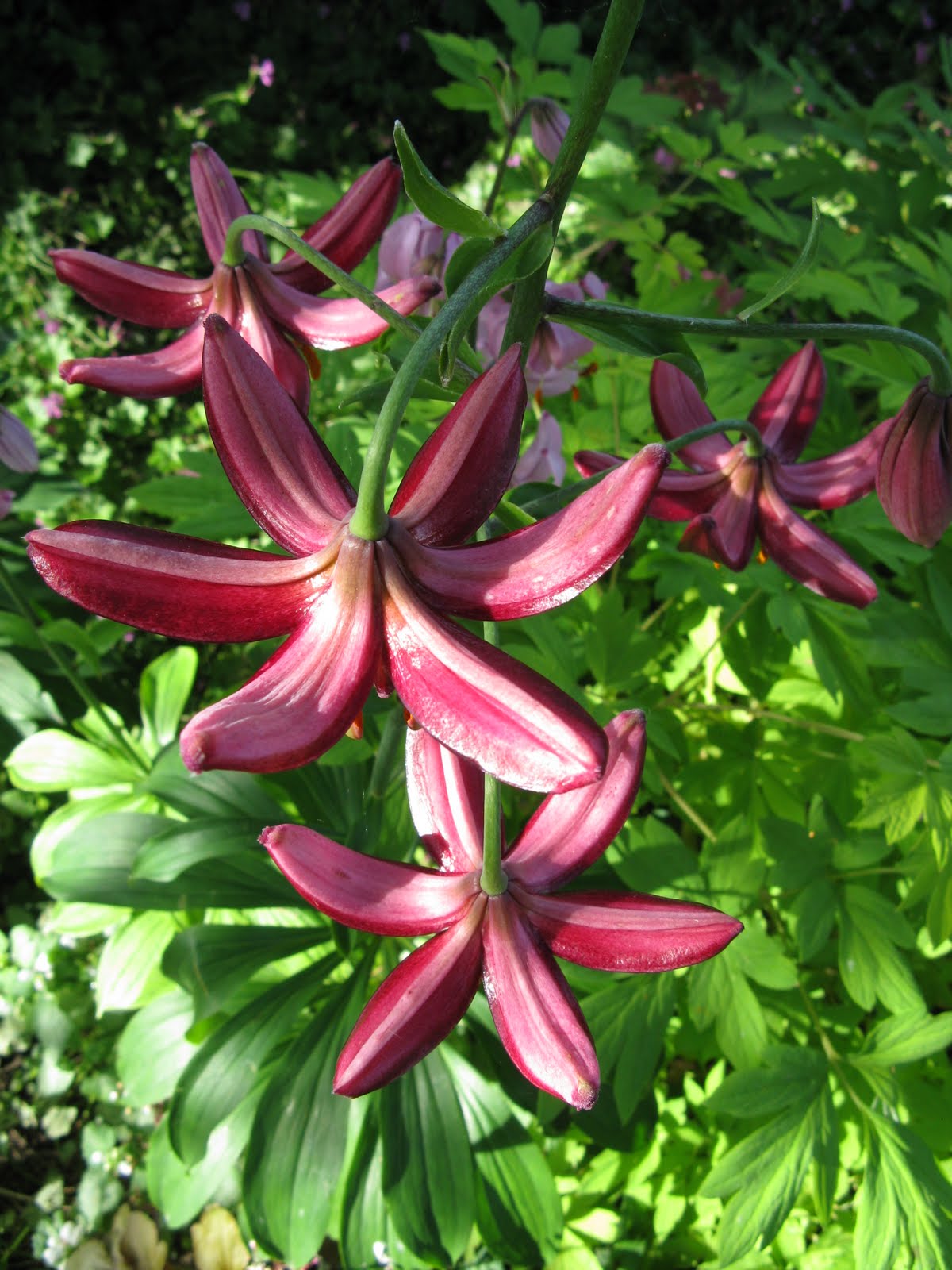
Following is what flowered this spring, from plants that were originally sown in 2006, and planted into my garden in 2008. Needless to say, I'm very impressed with these plants!
The book Lilies by Edward Austin McRae indicates that 'Painted Ladies' was developed by Edgar Kline of Oregon, and involves crosses between L. martagon (several forms), L. hansonii and L. medeoloides.

Unfortunately, production of this fabulous strain appears to be very limited.

Here's to dirt under your nails.

Mark, the coolplantsguy

Sunday, June 6, 2010

In its Native Habitat

Despite our best efforts as gardeners, at duplicating what we see in nature, and improving upon it with our own combinations and patterns, there is something wonderfully majestic about observing a favourite plant in its native habitat.

Such was the case a few weeks back, when I saw a beautiful stand of Aquilegia canadensis, the Canadian Columbine, on wooded and rocky outcrops along Twiss Road, just north of Burlington, Ontario.
The self-sowing tendencies of this plant were evident with several plants established on various levels of the outcrop, as well as in an actual row alongside the road. In my garden, I let it do its thing amongst Hostas, ferns and Martagon Lilies.

I've long been enamoured by this plant, preferring its grace and subtle beauty over the larger-flowered modern hybrids. Phillips and Rix state that it is pollinated by hummingbirds.
More recently, the dwarf strain 'Little Lanterns' has been very impressive, as well as the newer 'Pink Lanterns'.
Interestingly, Jelitto and Schacht record several forms of the species: "albiflora with white flowers, flaviflora flowers entirely yellow, and phippenii sepals pink, petals yellow" which must have been used to create the newer seed strains.

Here's to dirt under your nails.

Mark, the coolplantsguy

Saturday, May 22, 2010

Spring at the Nursery, Part 3

OK, now that "spring" is over, i.e. 80-hour work-weeks, blogging can return to a more regular schedule. While relatively crazy, I always appreciate the lessons learned from the industry's peak-season, and especially the new-plant experiences.

Case in point, is the re-discovery for me personally, of the genus Geum, one that had faded to near obscurity in recent years. New (and improved) introductions however, have turned the tide. Particularly impressive is the sterile selection called Totally Tangerine ('Tim's Tangerine'), pictured below, with very pleasant, re-blooming light orange flowers.
Another one I like is a Piet Oudolf selection called 'Flames of Passion' with slightly nodding flowers (on dark stems) of a very pleasant red-pink colour.
Here's a few other "miscellaneous" shots from the nursery this spring.

Centaurea montana 'Amethyst in Mist':
A new plant we are trying, Dianthus 'Fusion' from Walters Gardens' (Michigan) Kevin Hurd, with very nice bi-colour flowers:
Here's a close-up of the new Geranium 'Sandrine', the new and improved version from France, of the older and somewhat un-vigorous 'Ann Folkard'. The flowers are nearly twice the size.
This is an unidentified (I hate that), single white Peony:
I've long been a fan of the New Zealand 'New Millennium' series of Delphinium, but the 'Guardian' series is also superb:
Finally, a few shots from my "private stock", i.e. various new plants that we are trying this spring, including some plants from this spring that I simply must have. ;)
Heucherella 'Sweet Tea' has been amazing:
While slower, Heucherella 'Golden Zebra' has also been impressive:

Here's to dirt under your nails.

Mark, the coolplantsguy

Monday, May 10, 2010

Joy in the Garden

Great joy can be had when one grows a plant well in their own garden. This is especially the case when the plant is relatively rare on the street. The "oohs" and "aahs" of visiting friends and family can certainly be most gratifying, if not also feed our horticultural egos. ;)

Such is the case with two Arisaema (Jack-in-the-Pulpit) in my front garden. The first is A. kishidai 'Jack Frost', a very cool variegated form (of a Japanese species) I grew from Shady Oaks Nursery several years ago. The flowers are an interesting creamy-white with brown streaks.
As a definite and very significant bonus, each leaf has a beautiful silver stripe down the middle. I have found it relatively easy to grow.
Second, is A. sikokianum, another Japanese species, which is a special plant for me, as it was a gift from a good gardening friend. It has the completely inappropriate common name of Gaudy Jack, apparently in reference to the bright white spadix which sits inside and in contrast with the black-striped, green spathe. It has also been easy to grow.

These are both of course, relatives of our native Jack-in-the-Pulpit, A. triphyllum, easily seen during the spring in wooded areas of Southern Ontario. It is also rather variable, and I hoping to grow a selection with particularly dark-coloured flowers and foliage called 'Black Jack'.

Here's to dirt under your nails.

Mark, the coolplantsguy

Wednesday, April 28, 2010

Spring at the Nursery, Part 2

This is just a brief post of some pics of certain inspiring plants at the nursery over the last week or two.

A few from Papaver nudicaule 'Gartenzwerg' (Garden Gnome Iceland Poppy).
Next a couple of Aquilegia (Colubmine), first A. 'Origami Red & White', a superior form and then the newer A. canadensis 'Pink Lanterns', a plant I've been waiting patiently for years to finally see in full bloom.
Finally, a plant which I have a hard time not photographing each spring, Dicentra spectabilis 'Goldheart'.

Here's to dirt under your nails.

Mark, the coolplantsguy

Sunday, April 11, 2010

A Perfect Spring Day -- April 11, 2010

Like beauty, a perfect spring day is likely in the eye of the beholder. For me, such a day consists of getting work-work done in relatively good time -- that is checking on the crops at the nursery, and responding to any urgent emails, proceeding on with some garden work at home, spending some quality time with the family, and/or possibly while, checking out some cool plants. Of course, all under warm, sunny skies with a gentle breeze at 16C (61F).

Today was such a day. Here's a few pics from the latter part of the day.

First is Sanguinaria canadensis, the Bloodroot, both the single and double ('Multiplex') form, one of typical yet unique plants of spring. It is native to most of the eastern half of North America, and a red dye can be made from the dried root.
The Tulip is certainly another common harbinger of spring, but despite the impressive displays up in Ottawa and over in Holland, I can sometimes quickly tire of the large, modern hybrids, preferring rather the cute and dainty species. Here is Tulipa humilis:
Here's an Anemone, likely A. blanda, the Grecian Windflower:
The day would not have been perfect without some time with family. After a walk along Lake Ontario with the dog, I took my daughter Sarah along with me to the Niagara Parks' Botanical Gardens.
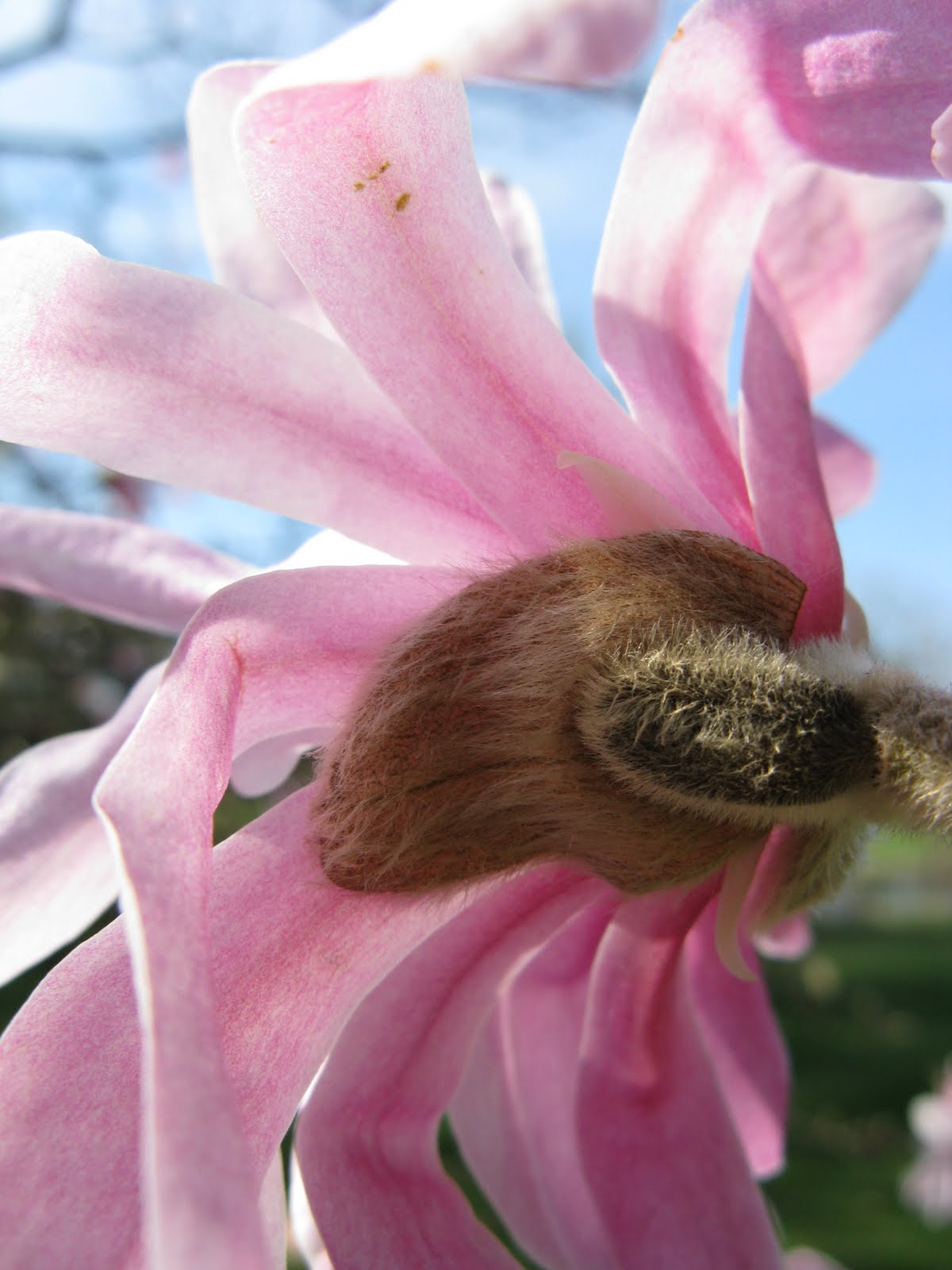
Finally, without much identification, as I've never been much of a "woody" guy, spring is never complete without a couple Magnolia or fruit tree flowers:

Here's to dirt under your nails.

Mark, the coolplantsguy